AGROECOLOGICAL TRANSITION
A GRADUAL PATH TOWARD LIVING AGRICULTURE
WHY GO THROUGH THE AGROECOLOGICAL TRANSITION?
Farmers who have adopted an agroecological approach report consistent improvements across multiple dimensions: greater food security, healthier soils, increased crop diversity through intercropping and agroforestry, reduced dependency on chemical inputs, and more diversified income sources that buffer against market volatility.
Peer-reviewed evidence shows that more complex agroecological systems — combining crop diversification, soil management, and farmer networks — are most strongly associated with lasting positive outcomes. The transition requires time and adaptation, but builds resilience that conventional systems cannot offer.
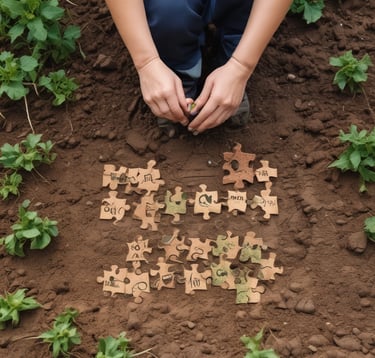
AN AGROECOLOGICAL PUZZLE
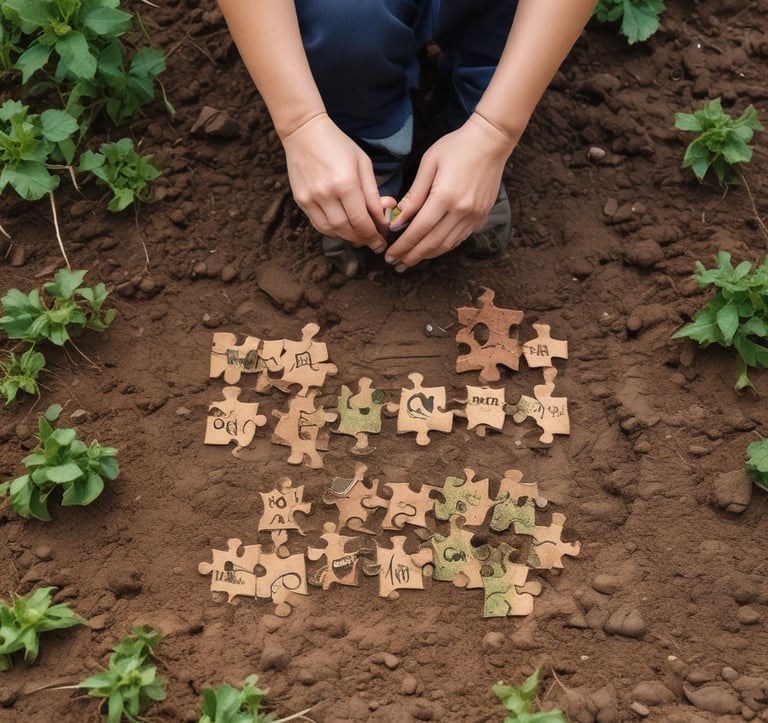
Agroecology is built like a puzzle: piece by piece.
There is no single correct way to assemble it, but every decision matters. By combining local knowledge, field experience, and available resources, farmers design their own sustainable model — one that is tailored to their land and rooted in their territory.
Beginning the agroecological transition is like opening a puzzle box without knowing exactly what the final image will look like.
At first it may seem complex, but with patience and close observation, the pieces begin to fall into place: soil management, crop rotation, livestock integration, family involvement, community participation — gradually forming a system that is more alive, more diverse, and more resilient.


WHERE DO I START?
"The best way to predict the future is to create it." (Peter Drucker)
Before placing the pieces, we need to envision the whole image we want to build. That means looking at the farm as a living system: the soil, the water, the seeds, the animals, the family, and the surrounding community.
We begin by understanding deeply what we already have, our resources, our strengths, and our real challenges, and then defining where we want to go: greater crop diversity, less dependency on external inputs, more biologically active soils, or a more stable family economy.
In my experience working across temperate and arid agroecosystems in Argentina and Switzerland, the farms that transition most successfully are those that start with honest observation before making any changes. The land always has something to teach before we begin to design.


AGROECOLOGY AS A WAY OF LIFE
Agroecology does not only transform agroecosystems — it transforms us.
It invites us to cultivate empathy and presence, to observe the land and the living beings within it with attention and respect.
Just as meditation teaches us to listen to ourselves with stillness, agroecology teaches us to listen to the rhythms of nature: the language of the soil, the pulse of water, the wisdom held in seeds, and the dynamics between species.
Both practices — meditation and agroecology — share the same underlying principle: conscious care.
In the field and in the mind, we sow attention, patience, and balance — so that a more harmonious relationship with life can flourish.
CONTACT ME
Over 10 years working at the intersection of agroecology, digital technology and environmental data science, helping turn sustainability commitments into measurable ecological impact in agroecosystems.
TELL ME ABOUT YOU